
Aug 18, 2026Services Overview
Why Does Wireless Charging Keep Disconnecting?
Wireless charging is designed to be simple: place your phone on the charger and let it charge. But if charging keeps starting and stopping, the experience can quickly become frustrating.
Wireless charging is designed to be simple: place your phone on the charger and let it charge. But if charging keeps starting and stopping, the experience can quickly become frustrating.
Here are the most common reasons — and how to optimize them.
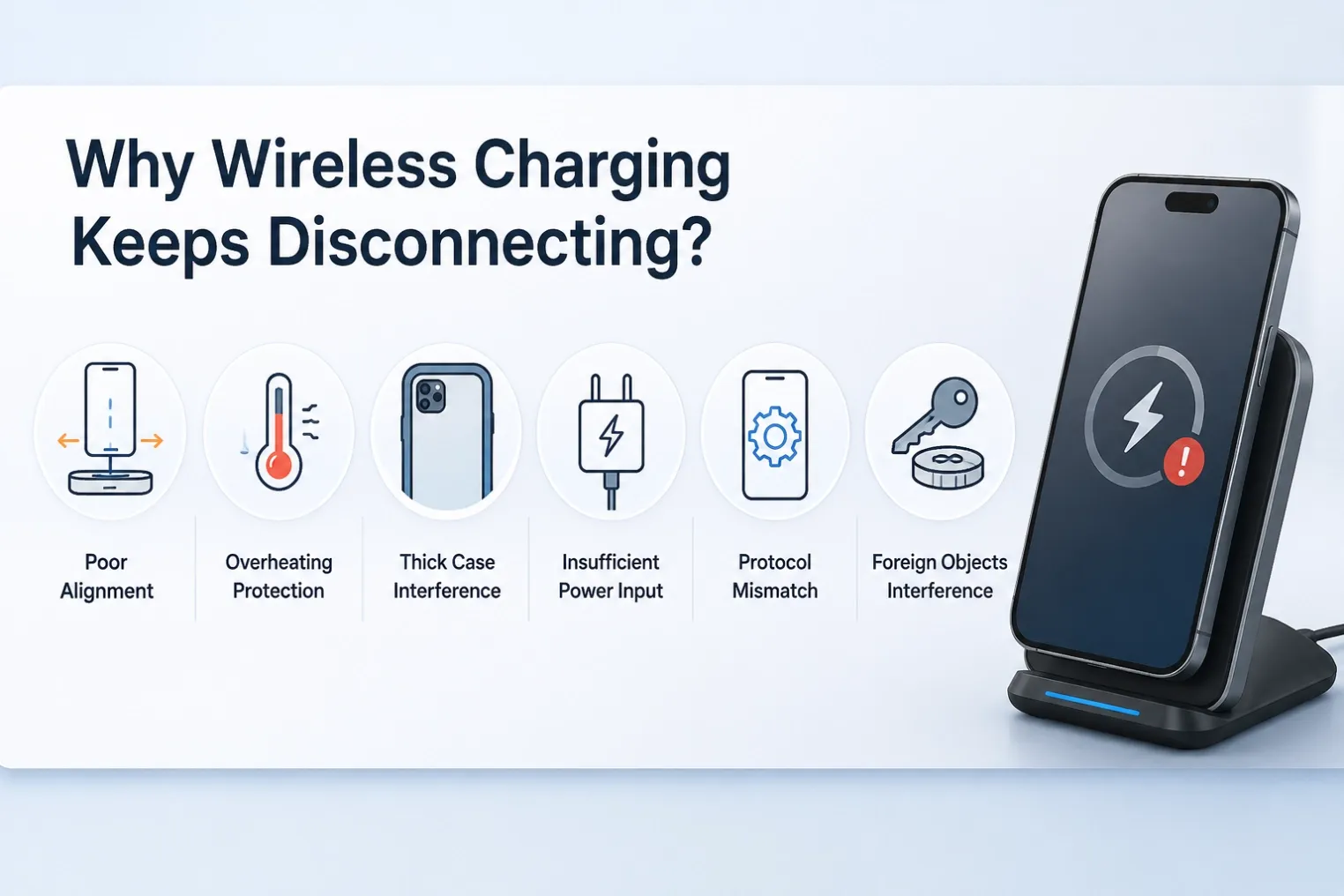
1.Poor Coil Alignment
Wireless charging relies on precise alignment between the transmitter and receiver coils. If the phone moves or is slightly off-center, charging may become unstable.
Solution: Use a larger, better-positioned charging coil and improve magnetic alignment, especially for Qi2-compatible products.
2.Excessive Heat
Wireless charging naturally generates heat. When the temperature becomes too high, the phone or charger may reduce power or temporarily stop charging to protect the battery.
Solution: Improve heat dissipation, optimize the charging circuit, and add intelligent temperature protection.
3.Incompatible or Thick Phone Cases
Thick cases, metal components, or poorly positioned magnetic rings can increase the distance between the charging coils and reduce charging stability.
Solution: Test the charger with different case types and optimize the magnetic and coil design for better compatibility.
4.Insufficient Power Input
A wireless charger may not reach its advertised charging speed if the power adapter or cable cannot provide enough power.
Solution: Use a suitable PD power adapter and high-quality cable, and clearly define the required input power.
5.Charging Protocol Compatibility
Different smartphones support different wireless charging protocols and power levels. Poor protocol compatibility can result in slow or intermittent charging.
Solution: Test the product across major smartphone models and optimize Qi/Qi2 protocol compatibility.
6.Foreign Objects or Interference
Metal objects, magnetic accessories, or other materials between the phone and charger can interfere with wireless power transfer.
Solution: Add Foreign Object Detection (FOD) and provide clear usage instructions.
How to Build a More Reliable Wireless Charger
A reliable wireless charger is not just about higher wattage. Stable alignment, effective thermal management, proper power input, protocol compatibility, and quality components all work together to deliver consistent charging.
For OEM/ODM wireless charger development, these factors should be tested under real-world conditions — including different phone models, phone cases, temperatures, and charging positions.
The goal is simple: Place. Charge. Stay connected.
Stable Charging Starts with Better Engineering.