
Oct 27, 2026News & Insights
Why Does a Wireless Charger Need an Alcohol Resistance Test?
Alcohol resistance testing verifies that a wireless charger's surface coating can withstand repeated alcohol wiping while maintaining its appearance and durability.
Why Does a Wireless Charger Need an Alcohol Resistance Test?
An alcohol resistance test evaluates the durability and stability of a wireless charger's surface coating under repeated alcohol exposure. It helps ensure the product maintains its appearance and surface finish during everyday use and cleaning.
Why Is Alcohol Testing Important?
Wireless chargers are frequently touched and may be cleaned with alcohol-based products. A weak surface coating can fade, discolor, or expose the underlying paint after repeated wiping.
The test helps verify:
- Surface coating durability
- Resistance to alcohol exposure
- Color and appearance stability
- Adhesion of the surface coating
- Long-term product durability
How Do We Perform the Test?
Test Condition: Room Temperature
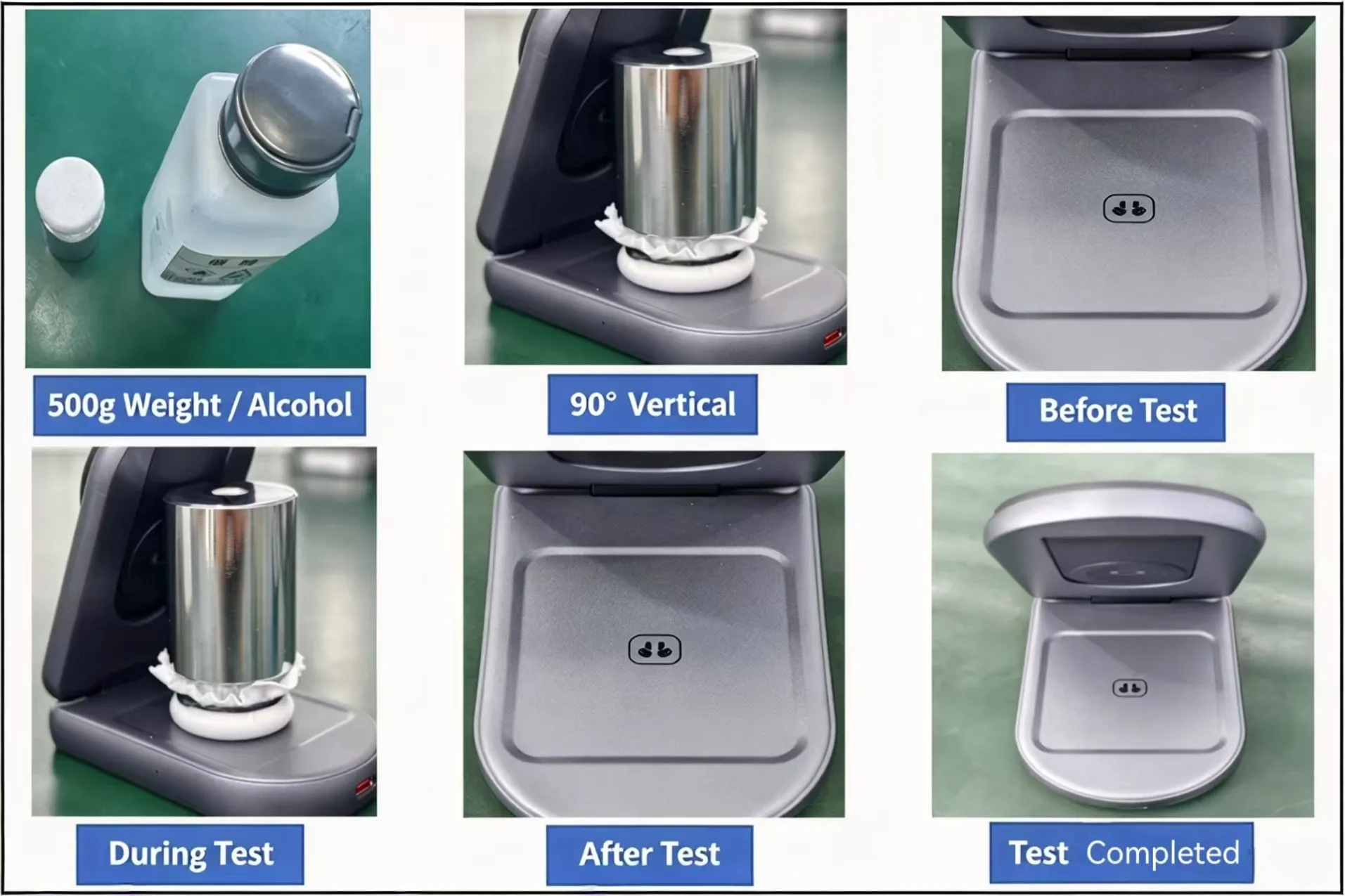
- Prepare 95% alcohol and folded cotton gauze.
- Fix the gauze to a 500g weight and apply alcohol.
- Rub the product surface at approximately 0.5 cycles/second, with a 3cm stroke distance and 500g load.
- Perform 30 back-and-forth cycles and inspect the surface.
What Makes the Test Qualified?
The test is considered PASS when there is no visible discoloration, coating damage, or exposure of the underlying paint after 30 cycles.
Test Result: PASS
After 30 cycles with 95% alcohol under a 500g load, the sample showed no exposed primer or visible coating damage.