
Oct 27, 2026News & Insights
How to Solve the Heat Problem in 25W Magnetic Wireless Charging?
Stable 25W wireless charging starts with better thermal design—separate heat sources from the coil and use active cooling to keep power stable.
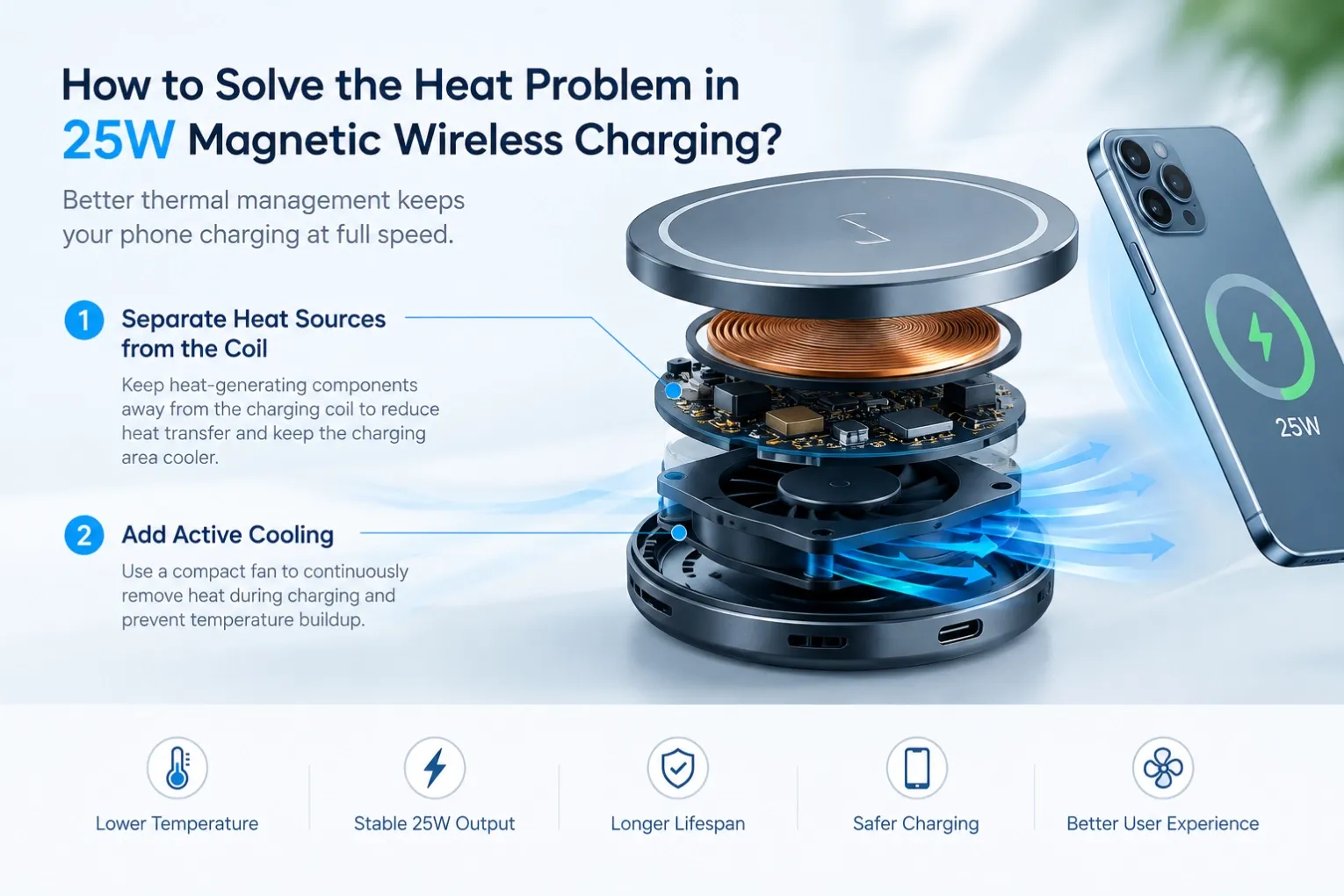
How to Solve the Heat Problem in 25W Magnetic Wireless Charging?
As wireless charging power increases to 25W, heat becomes one of the biggest challenges for magnetic wireless chargers.
When the temperature gets too high, the phone may automatically reduce charging power. So, how can we keep 25W charging stable?
There are two key solutions.
1. Separate the Heat Sources from the Charging Coil
The charging coil and heat-generating electronic components should not be placed too close together.
Through better internal structural design, we can separate the coil from the main heat sources, reducing heat transfer and keeping the charging area cooler.
This helps improve charging efficiency and long-term stability.
2. Add Active Cooling
Passive heat dissipation may not be enough for 25W charging.
By adding an active cooling system, such as a compact fan, heat can be continuously removed while charging.
The basic idea is:
25W Charging → Heat Generation → Active Cooling → Heat Removal → Stable Power
This helps prevent excessive temperature rise and reduces the chance of the phone lowering its charging power.
Stable 25W Is the Real Goal
For a 25W magnetic wireless charger, reaching 25W is only the beginning.
The real challenge is to maintain high-power charging while controlling heat.
At Cwin, we focus on thermal management from the early design stage, combining thermal isolation, active cooling, optimized structure and power management to develop more stable Qi2.2 / 25W wireless charging solutions.
25W is not just about higher power. It is about keeping that power stable.