
Oct 27, 2026News & Insights
How to Solve Heat Problems in High-Power Wireless Charging?
For 25W high-power wireless charging, effective thermal management combines heat isolation, better heat conduction, active cooling, and dynamic power control to keep charging fast, stable, and safe.
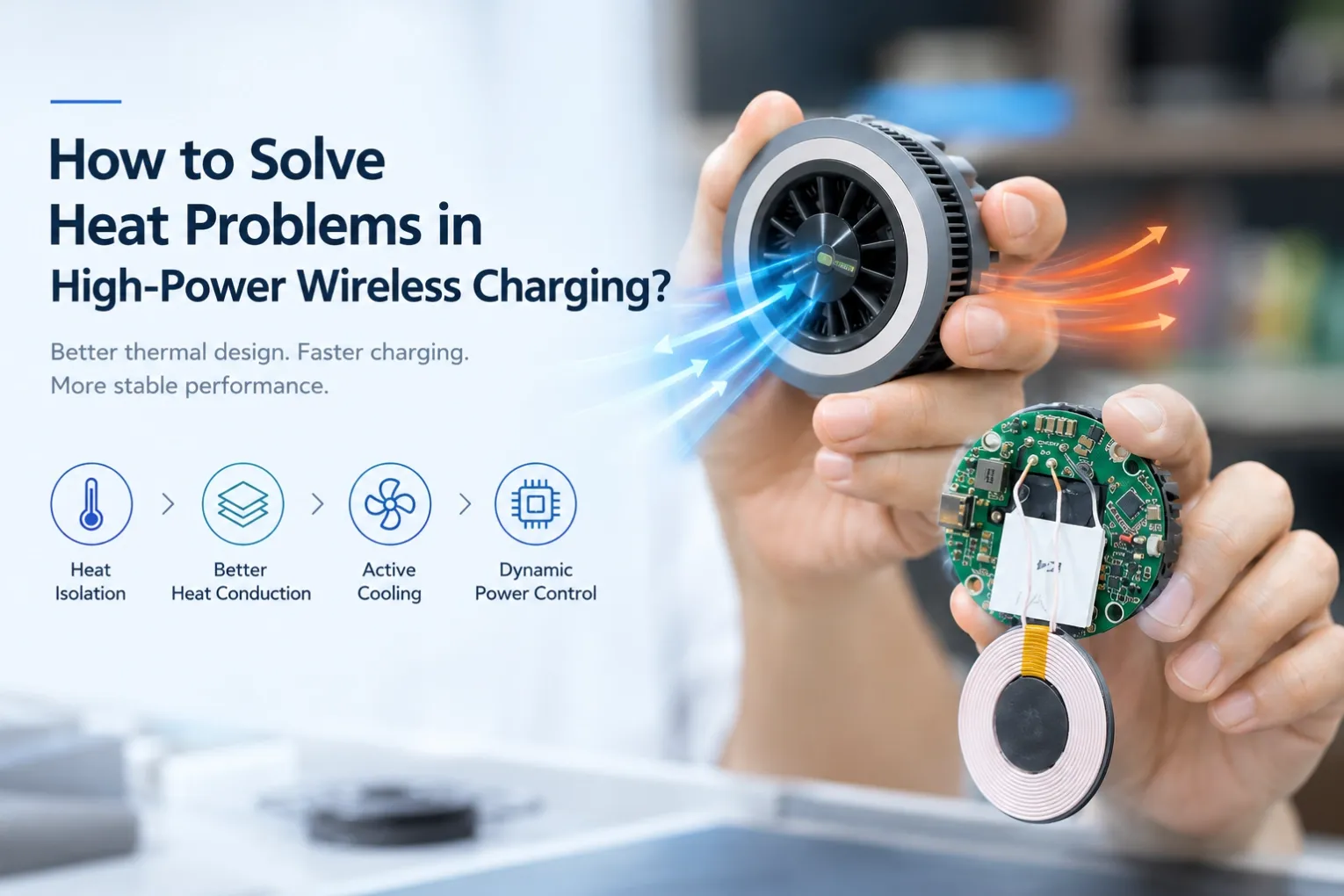
How to Solve Heat Problems in High-Power Wireless Charging?
As wireless charging power increases to 25W and beyond, heat has become a key challenge.
Higher power generates more heat in the charging coil, PCB, and smartphone. Without proper thermal management, the charger may reduce power to prevent overheating.
So, how can we solve the problem?
1. Separate Heat Sources
Use structural design to separate the charging coil from high-temperature components and reduce heat transfer.
2. Improve Heat Dissipation
Use high-thermal-conductivity materials, graphite sheets, or aluminum structures to spread and transfer heat away from the coil.
3. Add Active Cooling
For Qi2.2 25W wireless charging, active cooling such as a compact fan can help remove heat and maintain stable charging power.
4. Control Power Dynamically
Monitor temperature and automatically adjust charging power when necessary to balance speed, temperature, and safety.
In simple terms:
Reduce heat → Transfer heat → Dissipate heat → Control power.
For next-generation Qi2.2 25W wireless chargers, effective thermal management is essential for stable and reliable fast charging.
Cwin provides OEM/ODM wireless charging solutions with customized thermal management for high-power wireless chargers.