
Oct 27, 2026News & Insights
Wireless Charger FOD Testing: How Foreign Object Detection Works?
Learn how wireless charger foreign object detection (FOD) works, how FOD testing is performed, and what buyers should check when evaluating charger safety.
How Does Foreign Object Detection (FOD) Protect a Wireless Charger?
Foreign Object Detection (FOD) is an important safety function in wireless charging. It helps detect unwanted metal objects near the charging area and reduces the risk of excessive heating during power transfer.
For wireless charger brands, importers and distributors, FOD performance is an important part of product safety and reliability evaluation.
What Is Foreign Object Detection?
FOD is a protection function designed to identify foreign objects that may interfere with wireless power transfer.
Common examples include coins, keys and other metal objects accidentally placed between a phone and a wireless charger.
When a foreign object is detected, the charger may reduce power, stop charging or activate a warning, depending on its design.
How Does FOD Work?
Wireless charging transfers energy between transmitter and receiver coils. A metal object near the charging area can absorb some of this energy and generate unwanted heat.
FOD systems monitor relevant charging conditions to help identify potential foreign-object interference.
Depending on the charging system, detection methods may involve power-loss monitoring, changes in electrical characteristics or other control mechanisms.
When an abnormal condition is detected, the charger can trigger an appropriate protective response.
Why Is FOD Testing Important?
FOD testing helps verify whether a wireless charger responds appropriately when foreign objects are introduced into the charging area.
Key objectives include:
- Detecting specified foreign objects under defined test conditions
- Triggering the expected warning or charging protection response
- Reducing the risk of excessive heating
- Confirming that normal operation resumes after the object is removed
FOD performance should be evaluated alongside other safety functions, including overcurrent and overtemperature protection.
How Do We Test FOD on a Wireless Charger?
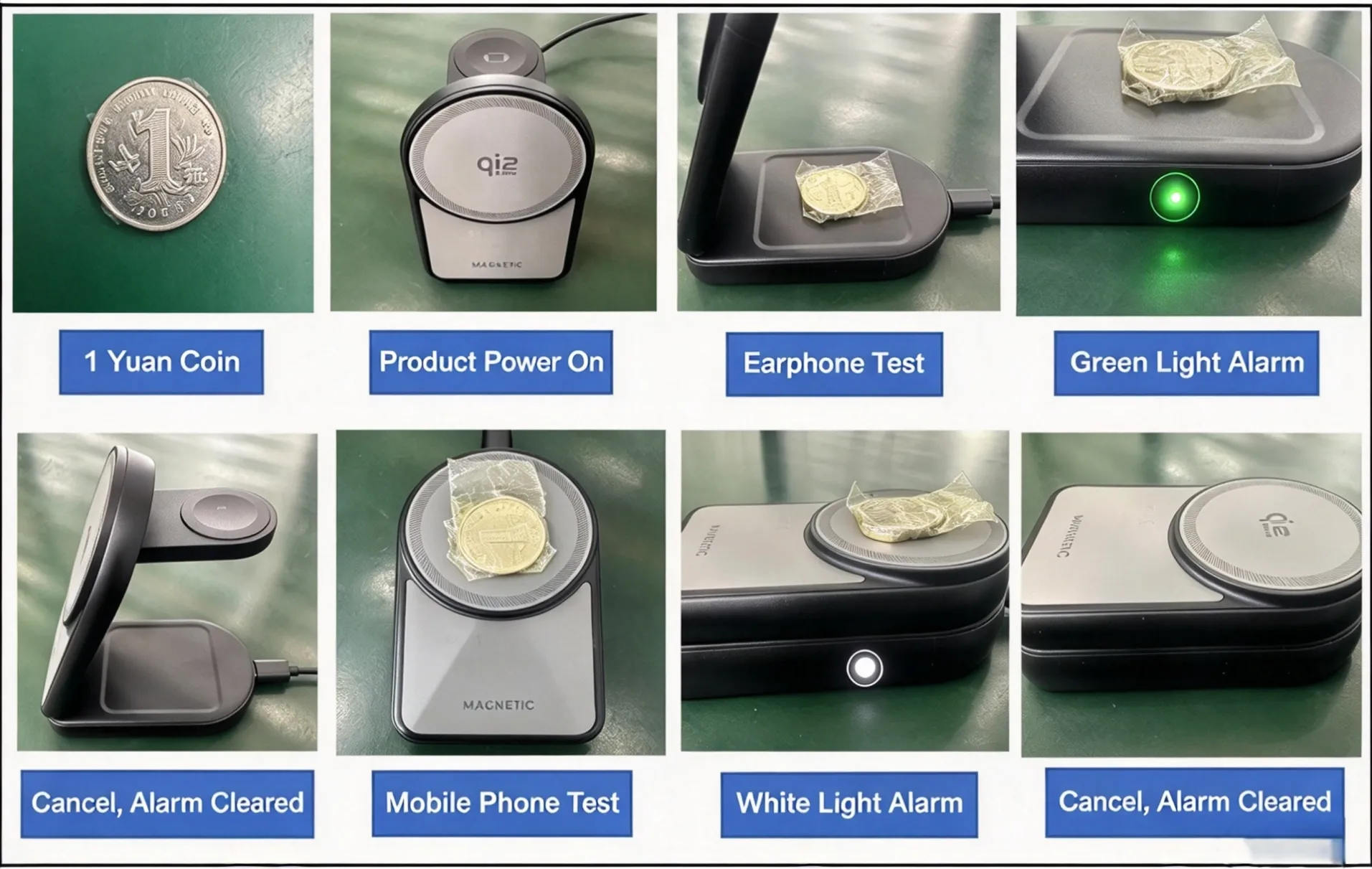
At CWIN, the following procedure can be used for a basic sample-level functional check. Formal compliance testing may require additional test objects, equipment and procedures.
Step 1: Prepare the sample
Connect the wireless charger to its specified power source and confirm normal operation.
Step 2: Place a test object
Place the designated metal test object on the relevant charging area. For the sample test described here, a RMB 1 coin was used.
Step 3: Observe the response
Check whether the charger activates the expected warning or protective response under the test conditions.
Step 4: Remove the object
Remove the coin and verify whether the warning clears and normal charging operation resumes.
Step 5: Record the result
Document the test object, charging area, power input, observed response and test result for traceability.
What Makes an FOD Test Pass?
The pass criteria depend on the product design and the applicable test procedure.
For the sample-level check described above, the expected result was that the charger detected the coin, activated a warning and returned to normal operation after the coin was removed.
The tested sample passed this functional check on both the phone and earbud charging areas.
This result applies to the tested sample and conditions. It should not be treated as proof of complete product certification or as a substitute for applicable formal FOD testing.
What Should Buyers Check When Evaluating FOD Performance?
When selecting a wireless charger supplier, buyers should ask:
- Does the product include FOD protection?
- Which test procedure and foreign objects are used?
- Are test conditions and results documented?
- Does the charger respond correctly when an object is detected?
- Is normal operation restored after the object is removed?
- Are FOD and other protection functions verified during product development and quality control?
Clear answers help buyers assess the supplier's testing process and product reliability.
FOD Testing for Wireless Charger OEM/ODM Projects
FOD is one part of a broader wireless charger safety and reliability program. Product design, coil positioning, power management, thermal control and device compatibility also affect overall performance.
CWIN supports wireless charging product development and OEM/ODM projects, including product customization, engineering evaluation and functional testing.
For brands and distributors developing new wireless charging products, FOD testing should be considered early in the design and verification process.
Looking for a reliable wireless charger supplier?
Contact CWIN to discuss wireless charger specifications, sample evaluation, quality testing and OEM/ODM requirements.